

Litigation Is a Last Resort — and That’s the Point
There’s a common assumption about litigators: that they want to go to court.
Sam Cohen doesn’t.
As a Townsville litigation lawyer with decades of experience in commercial disputes, Sam has learned that court should never be the first option. In fact, one of the clearest markers of an experienced litigator is how hard they work to avoid it.
“Once you’re in court, you’ve lost control,” Sam says. “You hand your outcome to a stranger in a robe, and no matter how strong your case is, you’re taking a risk.”
That belief underpins how Sam approaches every dispute at Cohen Legal — and why litigation is always treated as a last resort, not a default strategy.
A dispute is not the same as litigation
Most people don’t arrive at a law firm saying, “I’d like to commence litigation.”
They say, “I’m in a fight.”
Or, “I’ve been served with papers.”
Or, “Something’s gone wrong and I need help.”
That distinction matters.
A dispute is simply a disagreement — contractual, commercial, or financial. Litigation begins only once that dispute is formalised through a court or tribunal process, with strict rules and unforgiving timeframes.
Sam deliberately uses the word dispute first.
“Litigation is what happens when things have escalated,” she explains. “But good litigators try to resolve disputes before they get there.”
Once proceedings are on foot, flexibility disappears. Strategy narrows. Costs accelerate. Outcomes become harder to control.
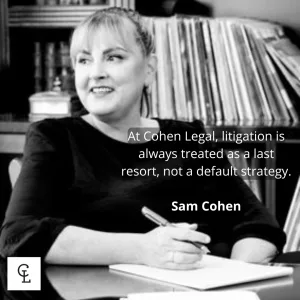
At Cohen Legal, we believe that litigation is the last resort.
What a litigator actually does
Not all lawyers handle disputes the same way.
Litigation is a distinct practice area. It requires a different mindset, a different tolerance for risk, and a constant focus on where a matter is likely to end.
“A litigator is always asking, ‘Where does this end?’” Sam says. “Not just, ‘Can I run this argument?’”
At Cohen Legal, disputes are approached strategically. Correspondence is written with an understanding of how it will be read by the other side — and how it may later be scrutinised by a judge.
Concessions are made carefully, if at all. Positions are taken with leverage and commercial reality in mind, not ego.
Because every step matters once litigation becomes a possibility.

Lawyer Reviewing Legal Documents Before Court Proceedings
A regional reality most clients never see
In a regional centre like Townsville, experienced litigators are increasingly rare.
Over the years, Sam has watched senior litigators leave private practice altogether — many moving to the Bar — leaving only a small number of practitioners with deep, hands-on litigation experience still practising locally in North Queensland.
“We’re a different breed,” Sam says. “It’s a different skill set.”
When you’re one of only a few lawyers regularly running complex disputes through courts and tribunals, you don’t approach litigation casually. You see patterns early. You understand where costs spiral. And you know how much damage can be done when matters are mishandled at the beginning.
“I’ve had cases come to me halfway through where concessions were made that never should have been,” Sam says. “At that point, you’re cleaning things up — and that costs people money.”

Cohen Legal Office In Townsville, North Queensland Litigation Firm
Court is expensive — in more ways than one
Litigation isn’t just costly in dollars.
It’s costly in time, energy, and emotional bandwidth. Matters can take a year or more to resolve. Businesses stall. Relationships deteriorate. Clients live with uncertainty.
Even when someone believes they’re right, that burden adds up.
“If I can resolve a dispute through negotiation or mediation in a few months, that’s almost always better than rolling the dice in court,” Sam says.
That approach doesn’t make her less of a litigator. It makes her a disciplined one.

Business Dispute Mediation Meeting Facilitated By An Experienced Mediator
Being served changes everything
There are times when litigation can’t be avoided.
If you’ve been served with a statement of claim — whether in a court or tribunal — you need a litigation lawyer immediately.
Timeframes are strict. Procedural mistakes are costly. Strategy matters from day one.
“This is where people often make the wrong choice,” Sam says. “They go back to the lawyer who did their conveyancing or lease. That lawyer might be excellent — but they’re not a litigator.”
Litigation requires experience with procedure, evidence, and pressure. It also requires knowing when to stop.

Representing Litigation In Court Is A Last Resort In Commercial Disputes
The goal is resolution, not theatre
Litigation is not performance art.
“The goal isn’t posturing,” Sam says. “It’s resolution — in a way that makes commercial sense.”
Sometimes that resolution comes through court. Often, it doesn’t.
By treating litigation as a last resort, Cohen Legal gives clients options — and clarity.
Clients aren’t rushed into proceedings. They’re prepared for them if needed. And that preparation alone often changes outcomes.
Why litigation should always be the last resort
Treating litigation as a last resort protects clients from unnecessary risk and preserves credibility.
When a matter does go to court, it’s because every other reasonable option has been explored. That history matters — to judges, mediators, and the other side.
It signals seriousness. It signals restraint. It signals judgment.
Litigation is a powerful tool. But like all powerful tools, it works best when used deliberately — and sparingly.
Sometimes, the strongest legal move is knowing when not to make it.
Make an appointment today to discuss your options with our team.
Disclaimer:
This article provides general information only and does not constitute legal advice. You should obtain advice specific to your circumstances before making any decisions.